Maize is a major staple crop grown worldwide, and its productivity depends on several agronomic factors, including plant density. Plant density refers to the number of maize plants grown per unit area and plays a critical role in determining yield, grain quality, and resource use efficiency. Optimizing plant density helps farmers balance competition for light, water, and nutrients, ensuring maximum productivity without compromising grain quality.
In semi-intensive and intensive farming systems, adjusting plant spacing according to soil fertility, irrigation availability, and cultivar characteristics is essential. Both under-planting and over-planting can negatively impact growth, resource allocation, and overall harvest quality. Understanding the relationship between plant density and maize performance is key to achieving high yields and sustainable production.
Table of Contents
Overview
| Aspect | Key Consideration |
|---|---|
| Yield | Maximum productivity per unit area |
| Grain Quality | Kernel size, weight, and nutritional content |
| Resource Competition | Water, nutrients, and light efficiency |
| Plant Spacing | Row and intra-row distance optimization |
| Lodging Risk | Taller plants in high-density fields prone to lodging |
| Sustainability | Taller plants in high-density fields are prone to lodging |
Impact on Maize Yield
Plant density directly affects maize yield. Higher densities can increase yield per hectare by maximizing the number of productive plants, but excessive density may cause competition for nutrients, water, and sunlight, leading to smaller kernels and weaker plants.
Conversely, low plant density reduces competition, allowing individual plants to grow larger and produce bigger ears. However, too few plants per area can result in underutilization of the available resources, lowering overall yield per hectare.
The ideal density varies depending on soil fertility, irrigation availability, maize variety, and climatic conditions. Modern hybrid varieties often tolerate higher densities without significant yield reduction, but careful management is still essential.
Effect on Grain Quality
Plant density influences grain size, weight, and nutritional content. In high-density fields, kernels may be smaller due to limited nutrient availability, while low-density planting often results in larger kernels with better filling.
Grain uniformity and moisture content can also be affected. Optimizing density ensures that maize plants develop evenly, producing uniform ears and high-quality grain suitable for consumption, processing, and storage.
Resource Competition
As plant density increases, competition among maize plants intensifies for sunlight, water, and soil nutrients. Insufficient resource allocation can limit leaf area development, photosynthesis, and overall biomass accumulation.
Efficient density management balances resource availability and plant growth. Adequate spacing allows each plant to access sufficient nutrients and sunlight, ensuring optimal photosynthesis and maximizing yield potential without overtaxing soil fertility.
Plant Spacing Considerations
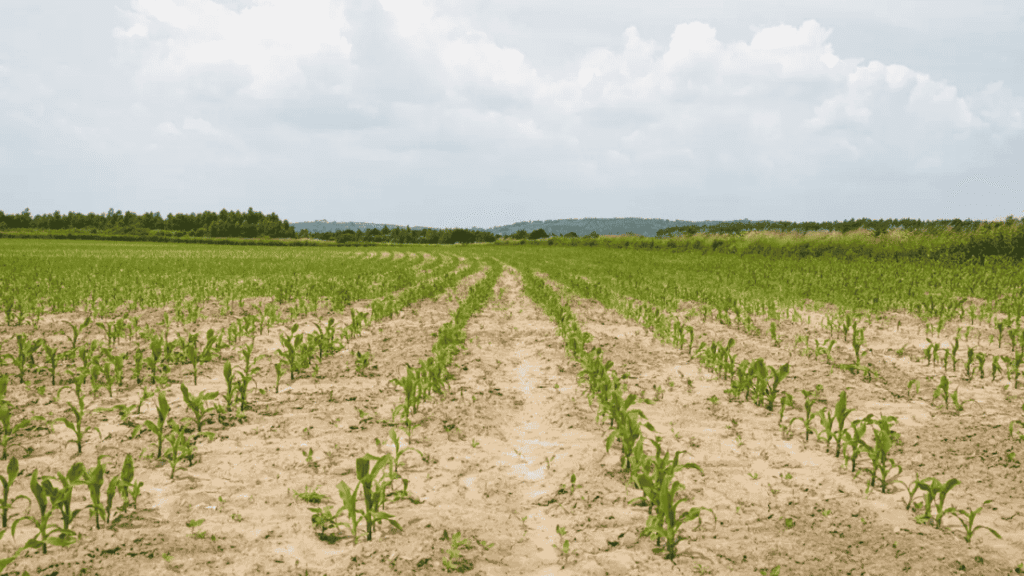
Plant spacing is a critical factor in determining optimal density. Row-to-row and intra-row distances should be tailored based on soil type, fertility, irrigation, and variety.
- Narrow spacing: Increases plant population but may raise competition and risk of disease due to poor airflow.
- Wide spacing: Reduces competition, improves light penetration, and enhances root growth, but may lower yield per unit area.
Careful adjustment of spacing ensures that maize plants grow healthily, maximizing both yield and grain quality.
Lodging Risk
High-density maize fields are more susceptible to lodging, where plants fall over due to wind, rain, or weak stems. Lodging can reduce harvest efficiency, grain quality, and yield.
To prevent lodging, farmers may need to consider variety selection, fertilization management, and appropriate plant density, especially in areas prone to heavy rainfall or strong winds.
Sustainability Implications
Optimizing plant density contributes to sustainable maize production. Correct density reduces unnecessary fertilizer and water use, prevents soil degradation, and maintains long-term soil health.
Integrating plant density management with other practices, such as crop rotation and soil fertility improvement, ensures efficient use of resources, higher yields, and reduced environmental impact.
Key Takeaways
Plant density is a key determinant of maize yield and quality. Properly managing the number of plants per hectare balances competition for resources, enhances kernel development, reduces lodging risk, and improves overall productivity. By optimizing plant spacing and density according to soil conditions, variety characteristics, and climatic factors, farmers can achieve high-yielding, high-quality maize crops while promoting sustainable agricultural practices.